
Philippines staffing research
Source reliability in Philippines outsourced operations research
Which source records can a Philippines operations specialist safely use when preparing a decision packet for an owner?
Question and scope
when a Philippines operations specialist prepares work from several systems, which source is reliable enough to support the next owner decision? Reliability here does not mean that a system is always correct. It means the source has a defined purpose, accountable owner, effective period, and traceable record that another reviewer can inspect. This distinction matters in outsourced operations because a specialist may see a CRM field, a shared spreadsheet, an email instruction, and a published policy that answer related but different questions. The study scope is one bounded process, one observation period, and a sample of records selected across routine work, incomplete requests, changed records, and exceptions. It does not rank vendors, countries, systems, or individual operators. Its practical aim is to help a buyer decide which evidence may be gathered by the delegated lane and which conflict must return to an authorized owner.
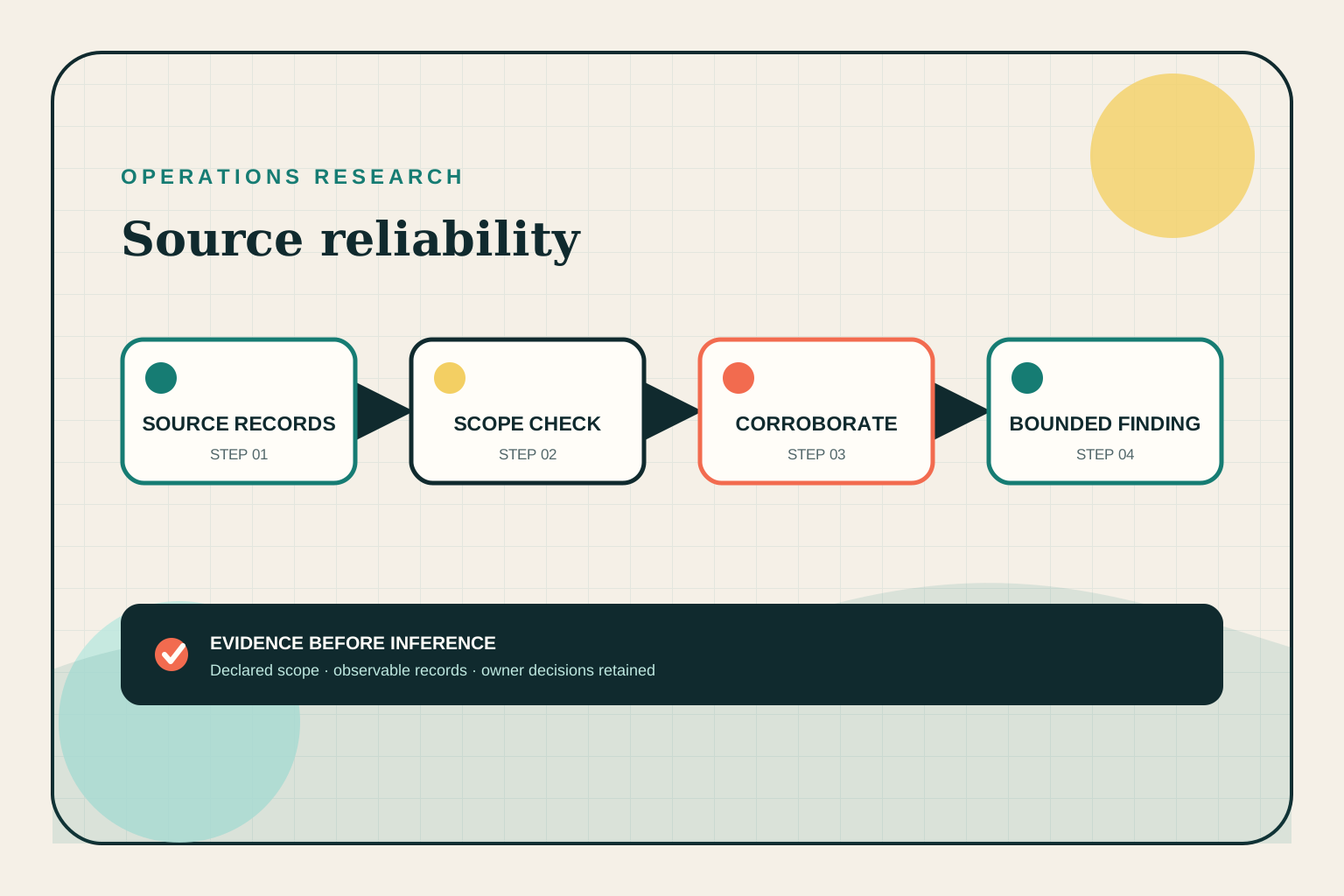
Methodology begins with a source register written before the sample is reviewed. For each candidate source, record its business purpose, steward, record type, update mechanism, effective-date rule, expected latency, access restriction, and relationship to other sources. Then define the question being answered: current status, historical event, customer statement, approved policy, financial amount, or next owner action. A source can be reliable for one question and unsuitable for another. Sample matched records where two sources should agree, plus cases where disagreement is expected because the timestamps or purposes differ. Preserve the original value, timestamp, and link. Classify the observation as corroborated, stale, conflicting, incomplete, or not applicable. Do not turn “most recent” into a universal precedence rule without evidence that the source is authoritative for that field.
Facts and analysis must remain separate. A record can show that a CRM status changed on a given date; it does not prove that the underlying customer decision occurred on that date. A policy page can state an approved rule; it does not establish that a particular request qualifies. An email can contain a clear instruction; it may still be outside the sender’s authority. The factual layer is the source content and its traceable metadata. The analysis is the narrower judgment that the source is adequate, inadequate, or requires owner confirmation for the defined question. Have a second reviewer classify the same sample using the same register. Disagreement is a result: it may reveal ambiguous ownership, an unrecorded change process, or a source that is overloaded with several purposes.
The role boundary should follow the evidence boundary. A Philippines specialist can locate approved sources, compare values, note dates, capture links, and prepare a concise conflict packet. The packet should state the question, confirmed facts, source disagreement, possible explanations, requested decision, and consequence of waiting. The specialist should not edit a source merely to make records agree, infer a missing value from a similar case, approve a policy exception, release money, alter security access, or promise an outcome to a customer. The owner decides precedence, remediation, and any consequential action. That separation lets the buyer inspect whether the process is failing at intake, source stewardship, access, or decision authority rather than blaming the person who surfaced the mismatch.
Evaluate the method with a small known-answer set and a live-but-low-risk sample. Report counts and denominators for each classification, including records excluded because the source was unavailable. Measure time to identify a usable source, rate of returned packets, unresolved conflicts, and the proportion of findings with a reproducible link. Do not treat fewer conflicts as improvement if reviewers stopped recording them. Check whether a system migration, policy revision, or change in owner coverage occurred during the period. Keep the register version and effective date beside every result. A finding that a source was stale may justify a change in ownership or refresh cadence; it does not prove that every record from that system is wrong.
The evidence scope has real limitations. Manual updates may lag the business event, automated logs may capture a click without the decision context, and shared documents may have incomplete history. A sample can miss rare but high-consequence conflicts. Privacy and security controls also constrain what can be copied into a research record; minimum necessary data is preferable to a large duplicate archive. NIST’s Cybersecurity Framework and Privacy Framework offer control language, CISA offers small-business security guidance, and FTC guidance discusses protecting personal information. These sources inform the questions in this study; they do not certify this company, its systems, or its suppliers.
Evidence-led conclusion: source reliability for Philippines outsourced operations is a field-specific, question-specific property that must be demonstrated through purpose, ownership, dates, and reproducibility. A buyer can safely delegate source gathering and comparison when the accepted sources and stop conditions are explicit. When two sources disagree and precedence is not documented, the strongest result is a visible owner question, not a confident correction. Recheck the register after a system change, policy change, access change, or repeated conflict. This conclusion supports better role design and safer handoffs; it does not establish a universal source hierarchy or a performance guarantee.
Retrieved 2026-08-20.
A useful decision record should also show what would change the classification. If a source becomes authoritative after an approved policy update, record the effective date and do not retroactively relabel older observations without noting the rule change. If two records reconcile after a documented correction, retain the original conflict and link the correction owner. If the disagreement persists, state whether the work can continue safely with a hold, a provisional label, or a narrower task. This makes the research useful to a Philippines operations buyer who needs to decide whether to improve intake, assign a source steward, add a review checkpoint, or keep the task owner-controlled. The specialist’s value is not choosing the most convenient record; it is reducing the owner’s search burden while preserving uncertainty. Review the source register at a declared cadence and after any system migration, field redesign, access change, or recurring discrepancy. A finding should expire when its source purpose changes. This is an operational control question, not a claim that one software category or outsourced team is inherently more reliable.