
Philippines staffing research
Reviewer-agreement evidence for Philippines outsourced support quality
How can a buyer tell whether a support quality rubric produces consistent judgments across reviewers?
Question and scope
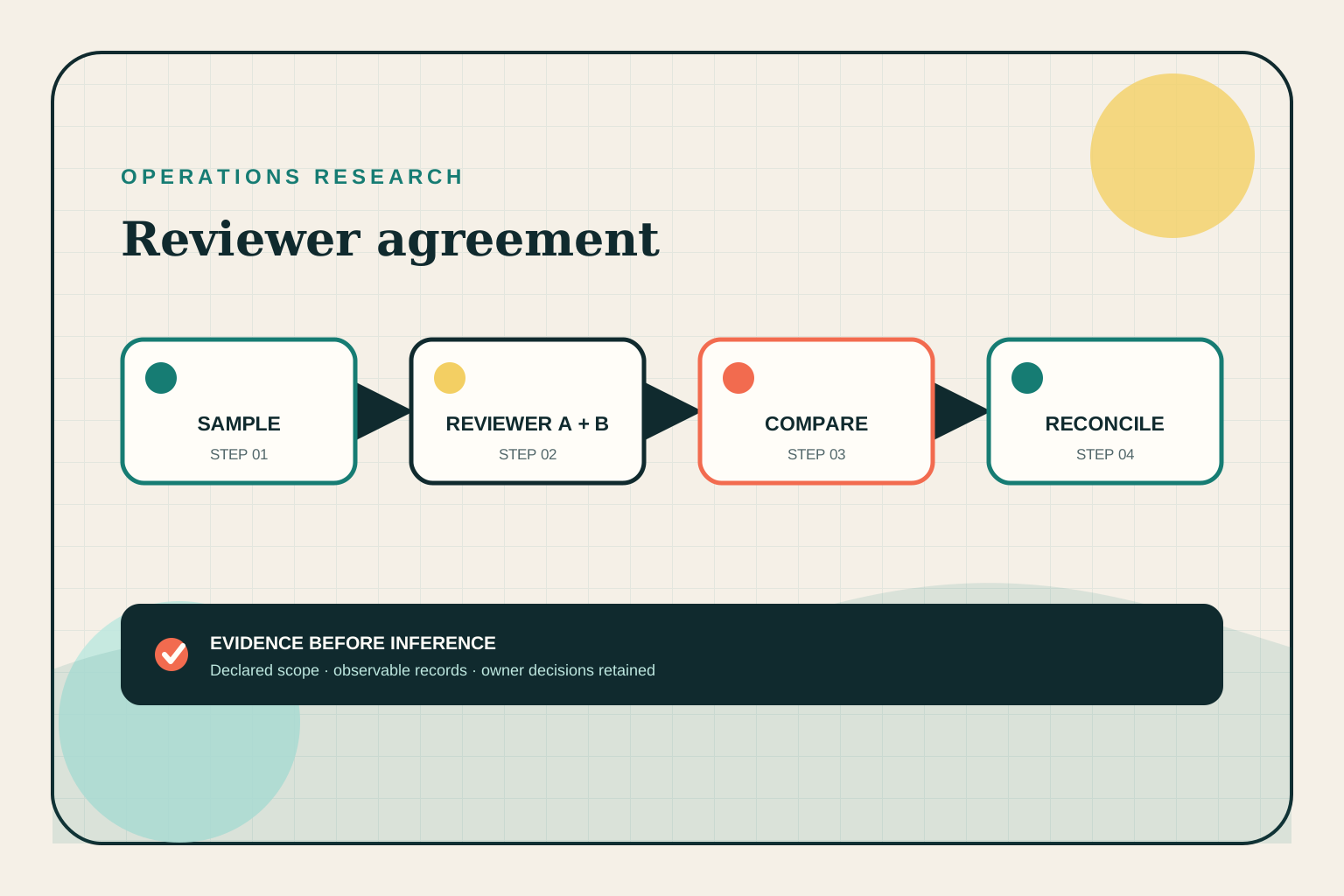
does a quality rubric lead different reviewers to reach the same bounded judgment about Philippines outsourced support work? Agreement is not proof that a rubric is correct, and disagreement is not proof that an operator failed. The study examines whether reviewers can apply defined criteria to the same evidence, distinguish a defect from an approved exception, and state when owner judgment is required. Scope one process, one rubric version, one observation period, and a sample that includes routine work and boundary cases. The result should inform training, rubric revision, sampling, or role boundaries, not produce an unsupported score for a person or supplier. Methodology: version the rubric, draw a stratified sample, collect independent blinded classifications, compare agreement by criterion, and review disagreement reasons before any calibration discussion.
Write the rubric before selecting the sample. Each criterion needs an observable unit, an evidence source, an acceptable range or condition, and a disposition rule. Avoid labels such as “good communication” unless the record defines what can be inspected. Stratify the sample by channel, case type, consequence, completeness, and outcome so easy cases do not dominate. Give reviewers the same evidence packet and record independent judgments before discussion. Preserve the rubric version, reviewer role, time spent, missing evidence, and reason for any override. A single blended agreement percentage can conceal that reviewers agree on routine formatting but diverge on consequential exceptions.
Separate observation, classification, and decision. The record may show that a response included a source link, but the reviewer still must decide whether the link supports the exact statement. Two reviewers may agree that evidence is missing while disagreeing about whether the item should stop or escalate. That disagreement reveals a role or rubric question, not automatically a quality failure. Review the disagreement log for ambiguous language, conflicting policies, inaccessible sources, and examples that do not cover the case. Do not coach reviewers toward agreement before recording their independent views; doing so turns measurement into consensus theater.
A Philippines support specialist can prepare work against the approved rubric, attach the relevant evidence, flag uncertainty, and request a review of a boundary case. They should not alter the rubric, waive a criterion, hide a defect, or convert a disputed classification into a customer commitment. The quality owner decides the standard, while an authorized business owner decides exceptions with customer, financial, privacy, security, or policy consequences. This separation lets a buyer test whether the role is receiving usable instructions rather than treating every disagreement as a hiring issue.
Analyze agreement by criterion and case class. Use counts, denominators, and a clear rule for missing evidence. Where appropriate, calculate a chance-adjusted statistic, but explain its assumptions and do not substitute it for the disagreement log. Compare false approvals and false returns on a known-answer subset if such a subset can be defined responsibly. Test the rubric with a small calibration round, revise only through the accountable owner, and then run a fresh sample. A rising agreement rate after examples are added may reflect genuine clarity or reviewers learning the answer key; both context and independent evidence matter.
Limitations are material. Reviewers may share an unstated interpretation, the sample may underrepresent rare risk, and the evidence packet may omit the customer context needed for a fair decision. Agreement cannot establish business impact, predictive validity, or a universal quality benchmark. NIST and CISA guidance can inform questions about traceability, access, and risk, while SBA guidance can inform supervision questions. These sources do not validate this rubric. Minimize personal information in calibration examples and retain only the evidence needed for a reproducible judgment.
Evidence-led conclusion: a quality rubric is useful for outsourced support only when its judgments are observable, its disagreement is preserved, and its boundary cases have an owner path. For Philippines operations, reviewer agreement can show where instructions or examples need improvement, but it cannot by itself prove that work is accurate, safe, or commercially successful. Keep the rubric version and re-test after policy, product, source, or reviewer changes.
Retrieved 2026-08-21.
The recommended output is a calibration record with the question, criteria, independent classifications, disagreement reasons, final disposition, and next rubric change. Report the small number of cases that required owner judgment instead of forcing them into a routine score. If the same ambiguity returns, that recurrence is stronger evidence for a policy clarification than a lower score is evidence against the operator. A useful quality study improves the boundary between preparation, review, and decision. Before adopting a revised rubric, test whether a new reviewer can apply it from the written examples without private coaching. Keep a small set of stable examples for later comparison, while adding new boundary cases when the process changes. If reviewers agree only after seeing the expected answer, label that result as calibration rather than independent agreement. The distinction protects the owner from mistaking familiarity with an answer key for evidence that the rule is understandable in live work. Also record whether each disagreement concerned evidence, interpretation, or authority. That split makes the next intervention testable: improve the source packet, rewrite the criterion, or name the decision owner. A score should never conceal that a reviewer lacked access to evidence or was asked to decide beyond the role boundary. Additional limitations include reviewer fatigue, a sample that underrepresents rare failures, and the possibility that a shared private interpretation makes agreement look stronger than it is. Agreement also cannot establish that the rubric predicts customer or business outcomes.
Interpretation guardrail: this report is a bounded study for a defined process, sample, and decision, not a universal benchmark for offshore work. Keep the evidence period, source system, reviewer rule, and exclusions beside every result. When a finding changes an operating choice, name the authorized owner, the smallest reversible test, the stop condition, and the evidence that would contradict the proposed interpretation. Separate routine preparation from customer, financial, privacy, security, policy, and personnel decisions. A Philippines specialist may gather, compare, classify, and route evidence under approved instructions; the accountable owner decides exceptions and consequential outcomes. Recheck the result after a material policy, system, access, calendar, role, or case-mix change. Do not turn a lower count into proof of improvement if recording behavior changed, and do not turn a higher count into proof of failure if detection improved. Preserve uncertainty when the source cannot distinguish competing explanations. This makes the report useful to a buyer planning safe delegation while keeping the public claim narrower than the evidence supports.