
Philippines staffing research
Review-load evidence for Philippines delegated operations
How to determine whether owner review is the real constraint before changing the scope of a Philippines support role.
Question and scope
when a Philippines delegated-operations queue feels slow, is the limiting factor preparation work, quality review, owner decision time, or the mix of cases? This question prevents a buyer from treating every long elapsed time as a staffing problem. Review load includes the time and cognitive work required to inspect evidence, resolve ambiguity, approve an exception, or return an incomplete packet. The study examines one process over a declared period and separates routine records from cases with owner, customer, financial, privacy, security, or policy consequences. It is not a productivity ranking and cannot produce a universal staffing ratio. Its purpose is to identify which part of the operating design should be measured before a scope change is proposed.
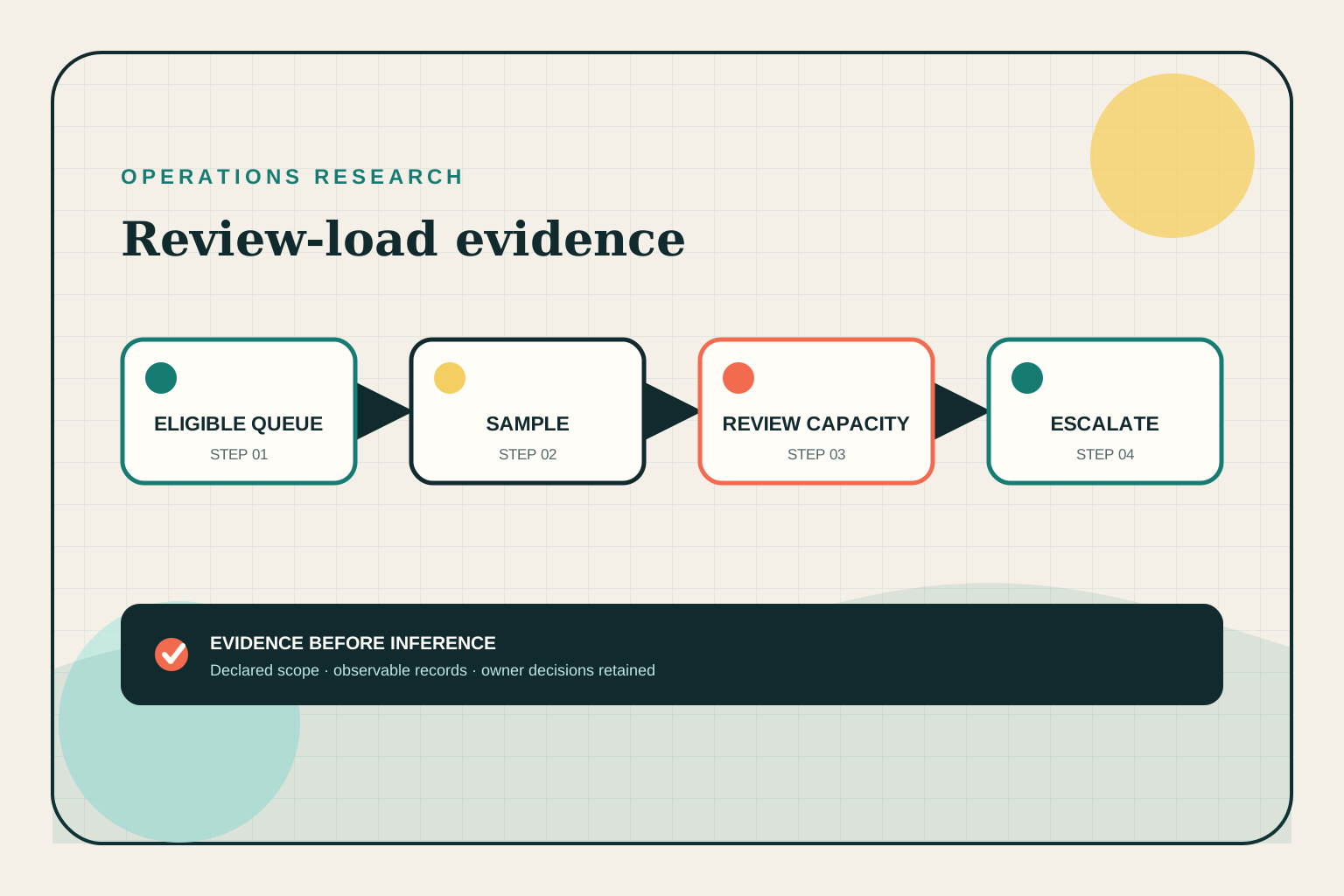
Build the measurement frame from events rather than impressions. Record eligible intake, complete-input time, active preparation, quality check, escalation, owner review start, owner response, returned work, and final disposition. Define what counts as active work and how business hours, weekends, holidays, and time zones are treated. Report median, range, and distribution by case class; a blended average can conceal a small group of high-risk reviews. Count the number of review touches and the reason for each return. If an owner reviews work informally in chat, classify that as a record limitation rather than pretending the review did not happen. Keep the numerator, denominator, period, and case mix beside every measure.
Observed review time is a fact; its cause is an analysis. A log may show that an owner spent 18 hours before responding. It does not show whether the packet was unclear, the decision was consequential, the owner was unavailable, or the case needed information from another source. Compare returned and accepted packets for missing evidence, unclear questions, duplicate effort, and disagreement about authority. Ask a second reviewer to reconstruct a sample. If review time falls after a new template, test whether the template improved evidence or merely shifted the work into unrecorded conversations. A sound finding names the evidence and keeps alternative explanations open until the sample can distinguish them.
Role boundaries make the result actionable. A Philippines specialist may assemble the source record, run approved completeness checks, label uncertainty, and present two clearly separated options when an owner has asked for them. The specialist should not decide an exception because the queue is aging, approve a payment, change a customer commitment, interpret a new policy, or close a record to improve a review metric. The owner or designated reviewer retains the consequential decision. If review load is high, the remedy may be a clearer approval question, a backup owner, a narrower intake rule, or a better source—not automatically another preparer.
Use a before-and-after design only when the definitions remain comparable. A pilot can change one variable, such as required evidence fields or owner coverage, and compare similar case cohorts. Measure preparation time, review time, returned packets, clarification cycles, and unresolved exceptions together. Record system changes, demand spikes, training, and owner absences. A reduction in review time paired with more corrections is not a clear improvement. Conversely, more review touches may indicate better detection of risk. Keep rejected or incomplete cases in the frame unless there is a documented reason to exclude them.
The evidence is limited by incomplete event logs, small samples, changing case mix, and the fact that careful review may be appropriate. A review-load study cannot prove that a person, location, or supplier caused delay, and it cannot promise a turnaround. NIST risk-management guidance, SBA material on supervision, CISA small-business resources, and BLS occupational context can inform control questions, but none supplies a benchmark for this process. Protect personal information in samples and use the minimum record needed for reproducibility.
How the study was structured
define the eligible request population, observation window, event timestamps, case strata, exclusions, and reviewer agreement rule before sampling. Reconcile a sample to the system of record, separate preparation from owner-wait intervals, and report counts with denominators. Sources used for control context are nist.gov, sba.gov, cisa.gov, and bls.gov These sources inform the method and do not establish a company-specific benchmark.
Evidence-led conclusion: a Philippines outsourced operations queue should be redesigned only after preparation, review, and owner-wait intervals are measured separately. If owner review dominates, clarify authority and coverage before expanding routine production. If preparation dominates, inspect inputs, source access, and rework. If review quality is inconsistent, improve the rubric and sample. This conclusion supports a bounded operating decision, not a universal capacity claim. Recheck after a policy, system, owner, or case-mix change.
Retrieved 2026-08-20.
A review-load register should make tradeoffs visible to the decision owner. Include the question sent for review, evidence attached, reviewer role, first response, requested clarification, final decision, and whether the packet was accepted without rework. Do not collapse these fields into a single “quality” score. A packet may be accurate but incomplete for a consequential decision; another may be long but poorly organized. Compare review touches by case class, not by operator alone, because complexity and authority shape the work. The Philippines specialist can improve the packet’s structure and evidence placement, while the owner controls the threshold for action. If repeated review returns point to missing policy, the right intervention may be a policy clarification or approved example. If they point to incomplete intake, fix the entry condition. If the owner has no available review window, document that coverage issue rather than allowing the specialist to improvise. The resulting measure should help a buyer choose a safe next experiment and specify the evidence that would falsify it.
A review-load finding is strongest when it identifies a decision that can be changed without weakening control. For example, the owner may revise the evidence order, publish an approved exception example, add a backup reviewer, or reduce unnecessary fields. Each change should be recorded with its effective date and assessed against the same case categories. Keep review time separate from the value of the decision; a thoughtful review may be slow for good reason. Conversely, speed without a traceable rationale is not proof of efficiency. This framing keeps a Philippines support role focused on preparation and makes the owner’s constraint visible without manufacturing a performance claim.