
Philippines staffing research
Queue-aging evidence for Philippines outsourced operations
When does an old outsourced queue item represent a control risk rather than ordinary elapsed time?
Question and scope
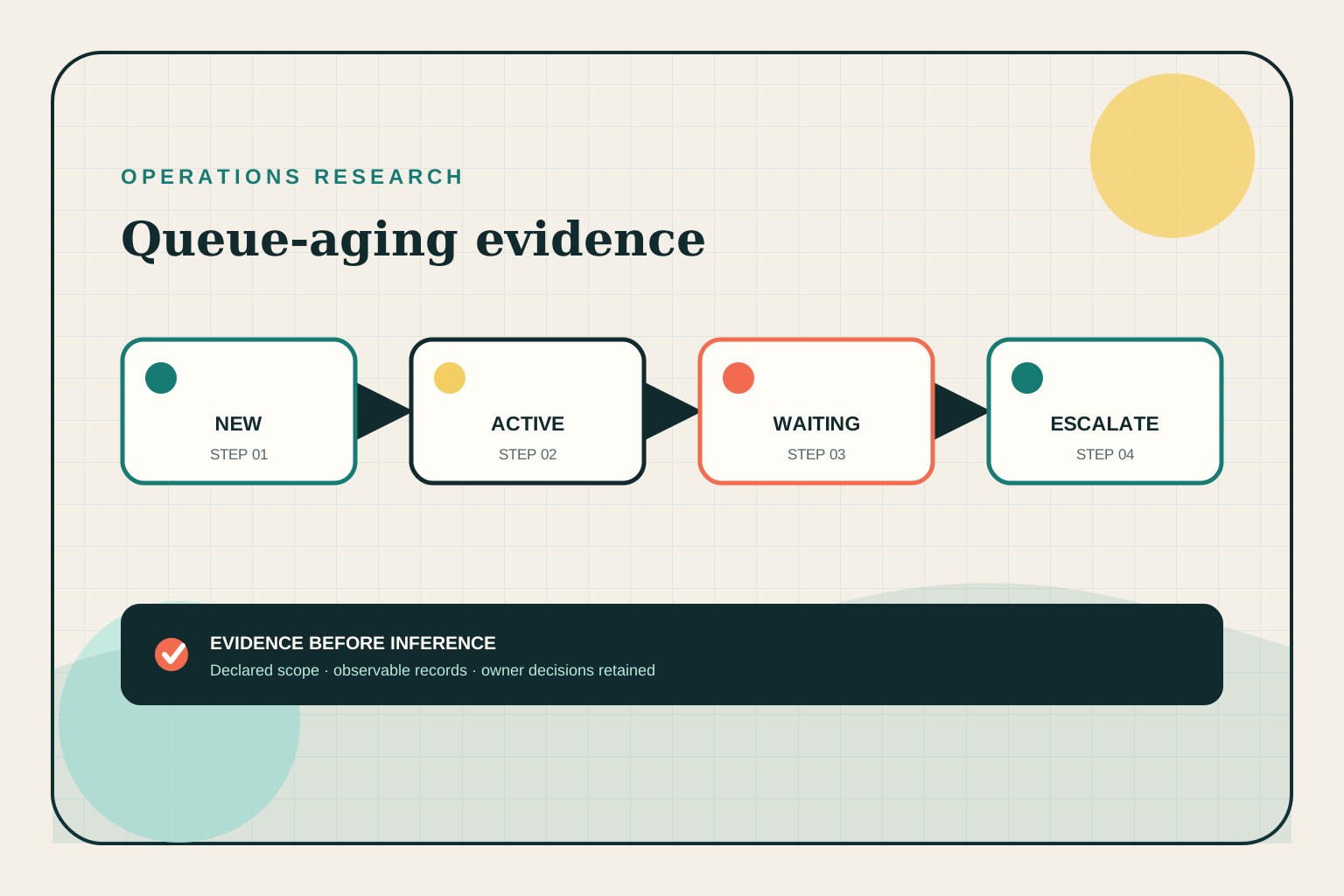
when does age in a Philippines outsourced operations queue indicate a control risk rather than ordinary elapsed time? The question matters because a single age number blends work that is actively being prepared, work waiting for a requester, work waiting for an owner decision, and work that has no accountable next action. This study examines one defined queue, one observation window, and a stratified sample of routine, paused, escalated, and completed records. It does not compare countries, suppliers, or individual workers. Its decision purpose is narrower: determine which queue states can remain within a delegated support lane and which states require an owner response or a change to the operating design. Methodology: define the queue population and observation window, stratify records by state and consequence, preserve source events, and have a second reviewer reproduce a subset of classifications.
The method begins by defining the clock. Record when the request became eligible, when complete inputs arrived, when preparation started, when the item entered a hold, when an owner was asked to decide, and when the disposition was recorded. Declare the time zone and business-calendar rule. Calendar age, active handling time, and owner-wait time answer different questions. Sample by age band and consequence rather than only by the oldest records. Include items that appear quiet, because an absence of activity may mean stable waiting, a missed acknowledgement, or a broken integration. Preserve the source event and calculate derived measures in a separate field so another reviewer can reproduce every interval.
Facts and analysis must stay distinct. A record can prove that a case remained in a queue for five days; it cannot prove that the Philippines specialist caused the delay. A long pause may reflect missing customer evidence, an unavailable approver, a policy ambiguity, or a system outage. For each sampled item, classify the observable state first, then identify the next accountable decision and the evidence supporting that interpretation. Have a second reviewer classify a subset without seeing the first result. Disagreement is useful evidence of unclear status definitions or incomplete context. Do not improve the apparent metric by changing a date, closing a waiting item, or moving an exception into a less visible category.
A delegated specialist can verify timestamps, apply approved age bands, identify missing inputs, prepare an escalation packet, and remind a named owner under a written rule. The role should not silently reprioritize work, promise a new customer outcome, approve a refund, make a security judgment, or close an item merely because it is old. The owner decides consequence and priority when the evidence does not establish an approved path. This boundary is particularly important in offshore work spanning time zones: a queue may be unattended locally while the business owner still retains the only authority to release a consequential action. The report should show where that authority is available and where it is absent.
Analyze age alongside consequence, not as a standalone leaderboard. Useful strata include customer-facing versus internal work, routine versus exception, complete versus incomplete evidence, and delegated action versus owner decision. Report counts and denominators for each stratum. Pair age with rework, reopened items, missed next actions, unresolved approvals, and correction notes. A falling backlog can be misleading if closure behavior changed; a rising backlog can reflect better detection of previously hidden work. If a new intake rule is introduced, compare like cohorts and mark the effective date. A simple before-and-after average is weak evidence when demand, policy, staffing, or system behavior changed simultaneously.
What this evidence cannot establish
the evidence scope has limits. A short sample can miss seasonal demand, outages, or rare high-consequence events. Exported timestamps may not preserve the original system history, and a customer may wait outside the queue after an internal status says complete. Privacy constraints may limit the detail that can be copied into a research register; use minimum necessary identifiers and link to the approved source. NIST and CISA guidance support treating security, access, and risk context as part of an operating process, while SBA guidance provides general supervision context. None of these sources creates a benchmark for this company or proves that a particular queue design will perform.
A sound finding names the intervention it can support and the evidence that would overturn it. If owner-wait time dominates, define review windows or backup authority before expanding preparation capacity. If incomplete intake dominates, improve the entry condition. If age is concentrated in a high-consequence exception class, narrow the role and make escalation visible. If timestamps cannot be reconciled, fix source stewardship before interpreting a trend. Keep the original sample, definitions, and exclusions so a later study can distinguish genuine change from changed measurement. The specialist contributes reliable classification and evidence; the authorized owner chooses the risk response.
Evidence-led conclusion: queue age becomes decision-relevant when it is tied to state, consequence, evidence completeness, and accountable next action. For Philippines outsourced operations, the safest use of an aging study is to expose where a delegated lane stops and where owner coverage must begin. It does not justify a universal turnaround claim, a staffing promise, or a judgment about a person or location. Re-run the sample after a material policy, system, calendar, access, or case-mix change.
Retrieved 2026-08-21.
A practical research record should therefore preserve the queue snapshot, the sampling rule, the calculation logic, and the reviewer notes. Record why an item was excluded and whether the exclusion could bias the result. Keep separate fields for “old,” “blocked,” “awaiting owner,” and “no next action”; they are not interchangeable. When the report recommends a small pilot, specify the one changed control, the comparable cohort, the review owner, and the stopping condition. This makes the conclusion testable without pretending that elapsed time alone explains an operational outcome.
Interpretation guardrail: this report is a bounded study for a defined process, sample, and decision, not a universal benchmark for offshore work. Keep the evidence period, source system, reviewer rule, and exclusions beside every result. When a finding changes an operating choice, name the authorized owner, the smallest reversible test, the stop condition, and the evidence that would contradict the proposed interpretation. Separate routine preparation from customer, financial, privacy, security, policy, and personnel decisions. A Philippines specialist may gather, compare, classify, and route evidence under approved instructions; the accountable owner decides exceptions and consequential outcomes. Recheck the result after a material policy, system, access, calendar, role, or case-mix change. Do not turn a lower count into proof of improvement if recording behavior changed, and do not turn a higher count into proof of failure if detection improved. Preserve uncertainty when the source cannot distinguish competing explanations. This makes the report useful to a buyer planning safe delegation while keeping the public claim narrower than the evidence supports.