
Philippines staffing research
Permission scope in Philippines outsourced support roles
A bounded study of whether a Philippines operations role has the access needed for routine work without exposing unrelated data or authority.
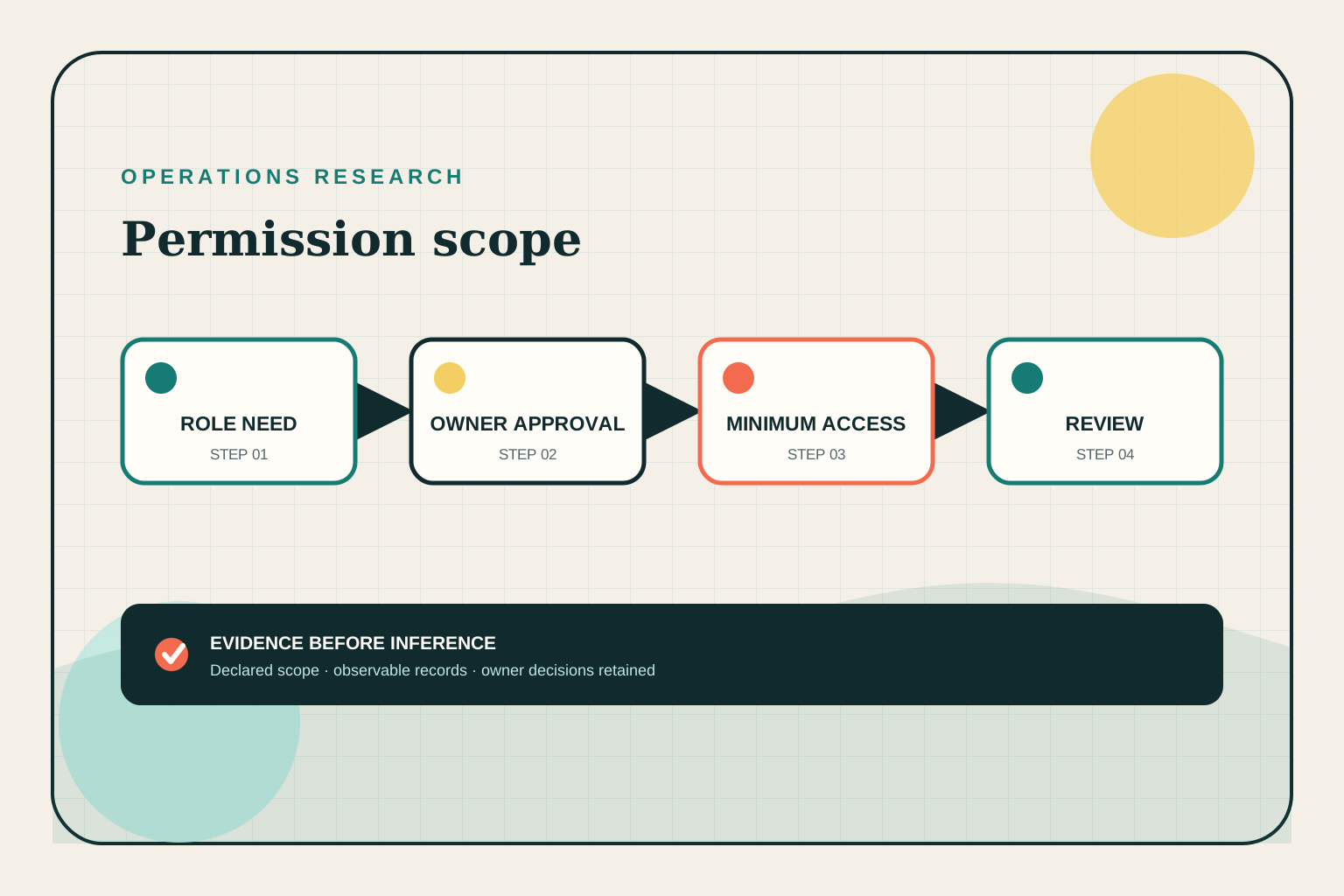
Question and scope
does the access granted to a Philippines outsourced support role match the narrow work the role is approved to perform? Permission scope has two dimensions: what the account can do and what the operator actually needs to see or change for the task. A role title is not evidence of either. The study covers one process, its source systems, a declared sample of permissions and activity, and a recent role or workflow change where available. It does not certify security, establish legal compliance, or infer intent from a log. It helps a buyer decide whether the role boundary, access request, and review evidence are specific enough for safe delegation.
Create a role-to-data map before examining events. For each system, record record type, permitted action, purpose, sensitivity, approver, review date, expiry trigger, and owner. Then sample actual views, edits, exports, and administrative events against the task record. Classify each event as necessary, unnecessary but explainable, unexplained, or potentially prohibited. Investigate automated events and shared-service activity separately. A missing log is a control limitation; it is not proof of misuse or safety. Preserve system name, event time, account identity, and evidence link while minimizing copied personal information.
The factual layer is an entitlement or activity record. The interpretation is whether the event fits the approved purpose. Opening a customer record may be necessary for a support task, but it does not prove that an edit was authorized. An export may be a scheduled system action rather than an operator choice. Ask the system owner or security owner to resolve ambiguous events. A second reviewer should reproduce classifications from the same evidence. Agreement between reviewers does not prove the permission is correct; it only shows that the current rule was applied consistently.
A Philippines specialist can work within named-account, least-privilege access, flag a missing field, maintain the access register, and prepare a review packet. The role should not request broad permissions for convenience, use another person’s account, disable controls, approve its own access, or expand scope because a queue is old. The system or security owner approves privileged actions, handles offboarding, and decides remediation. A safe stop is a productive result when the approved role cannot complete the task without a consequential permission change.
Evaluate a small set of systems and a recent change, then recheck after remediation. Measure stale approvals, permissions broader than the task, unexplained events, export events, review completion, and time to correction. Note whether the sample includes normal work, exceptions, and records outside the assigned queue. Do not judge the control by the absence of a reported incident. Compare the documented purpose with observed use, and preserve the original finding even if the permission is later corrected.
The study is limited by incomplete logs, shared accounts, automated integrations, changing role scope, and samples that cannot represent every system. NIST Cybersecurity and Privacy Frameworks, CISA ransomware guidance, and FTC privacy guidance offer useful control questions; they do not make a company secure or determine an authorization decision. Use minimum necessary data in the research record and restrict access to the reviewers who need it.
How the study was structured
create the role-to-data map before reviewing activity, sample views and edits across ordinary and exception work, classify events with a second reviewer, and preserve system, account, timestamp, purpose, and evidence fields. Sources used for control context are nist.gov, nist.gov, cisa.gov, ftc.gov, and sba.gov
Evidence-led conclusion: permission scope is credible when a defined task, approved purpose, named account, narrow entitlement, observed use, and review trigger line up. When they do not, the correct outcome is a flagged mismatch and owner remediation, not a quiet workaround. This supports safer Philippines outsourcing role design without making a claim about any individual or location. Recheck after systems, tasks, owners, or access policies change.
Retrieved 2026-08-20.
A role-to-data review should distinguish necessity from convenience. If a specialist cannot complete routine work without seeing unrelated records, first ask whether the task can be redesigned, filtered, or split before granting broader access. If the necessary permission is missing, record the exact field and action rather than requesting an entire administrative role. The access owner can then decide whether to adjust the system, provide a controlled view, or retain the task. Recheck removals after a role transfer and at the end of approved work, because expiry evidence is part of scope. Where activity logs are ambiguous, improve account identity or event interpretation instead of assigning intent. For a buyer, the important result is a traceable relationship among task, purpose, entitlement, observed use, and corrective action. That relationship supports safe delegation while making the stop condition explicit. It does not replace a security program, a legal review, or an incident-response process.
Access scope should be reviewed alongside the work instruction. An instruction that says “check the account” is too broad to define a permission; it should identify the record, fields, permitted action, source, and escalation path. Test a low-risk sample using the narrowest role available and ask whether the operator can complete the routine step without opening unrelated data. If the answer is no, the evidence supports a system or process redesign question. If an owner expands access, retain the approval, reason, expiry or review date, and post-change check. This gives the buyer a measured way to increase scope without treating trust as a substitute for authorization.
The review should record false positives as carefully as true mismatches. An automated report may look like an unnecessary view until its service purpose is confirmed; a manual event may look routine until the task boundary is read. Keep the classification provisional until the system owner resolves it. This protects the operator from an unsupported allegation and protects the business from dismissing a real control gap.