
Philippines staffing research
Handoff continuity evidence in Philippines support operations
What proves that outsourced work remains owned across shifts, absences, and time-zone boundaries?
Question and scope
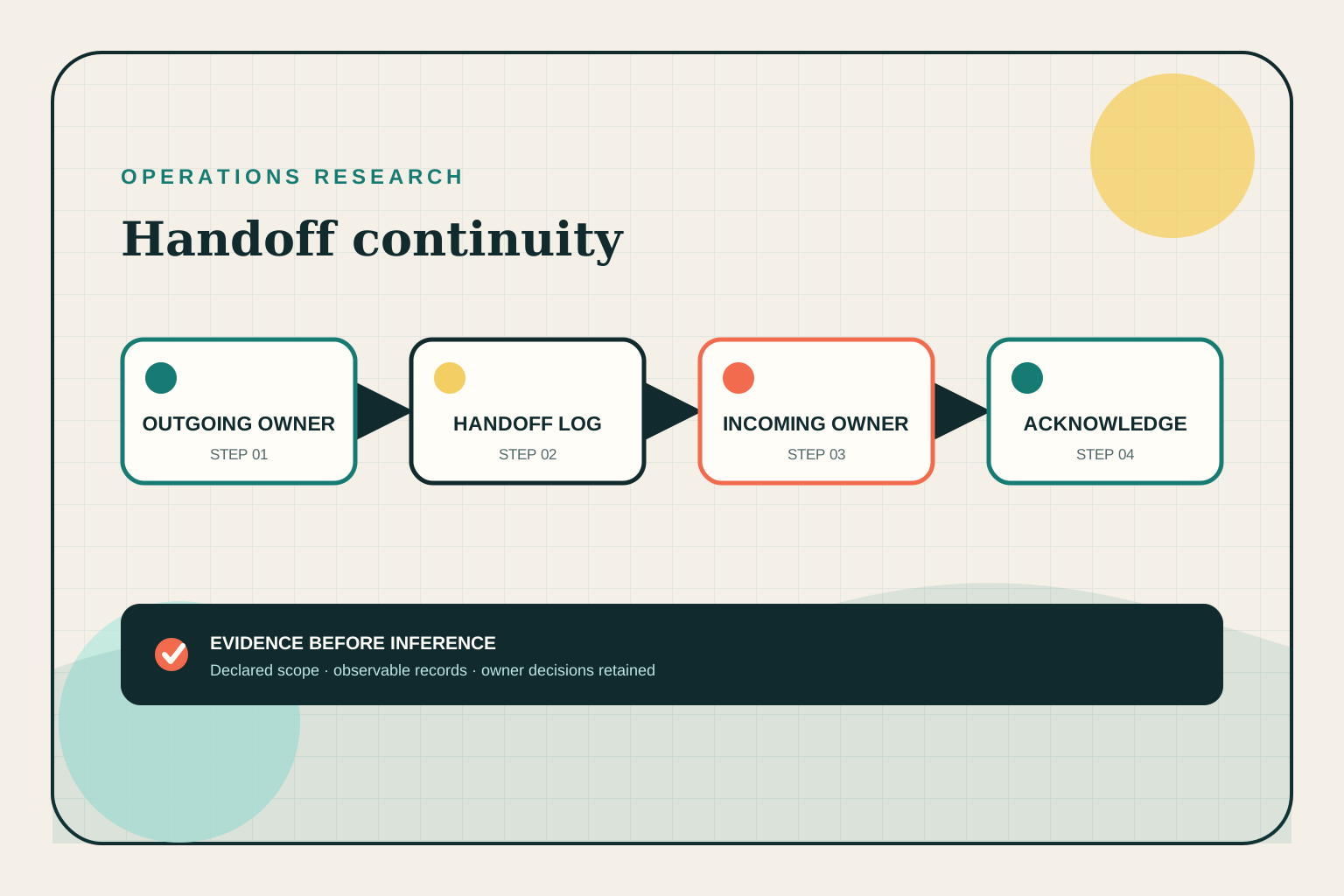
what evidence proves that a Philippines support item remains owned when it crosses a shift, absence, holiday, or time-zone boundary? A handoff message is not the same as continuity. Continuity requires a reproducible current state, a permitted next action, a named receiver, and a route for decisions outside the delegated role. The study scope is one queue and a declared sample of ordinary, incomplete, escalated, and reopened items. It evaluates the handoff record, not the personality or effort of the people involved. The buyer decision is whether the current transition design preserves accountability without requiring the receiver to reconstruct a long conversation or invent authority. Methodology: define each transfer event, sample successful and failed transitions by consequence, test reconstruction from the packet alone, and retain independent reviewer findings before discussing disagreements.
Define a handoff event before reviewing outcomes. Capture the last verified state, the source record, evidence still needed, the next permitted action, the next review point, the receiving role, and the escalation destination. Include the local time and the business time used by the owner. Sample accepted handoffs and failures, including items that appeared to transfer successfully but later reopened. A forwarded message may be a source artifact, but it should not be counted as acceptance until the receiving role can identify the state and next action. Record missing acknowledgements separately from missing context; they require different interventions.
Treat the record as facts first and interpretation second. A timestamp shows when a packet was sent, not that the receiver understood it. An opened ticket shows access, not authority. A returned item shows that the receiving lane could not complete the next step, but not whether the cause was poor preparation, missing policy, unavailable evidence, or an owner decision that was never assigned. Ask a reviewer unfamiliar with the original thread to reconstruct a sample using only the handoff packet and approved source. The questions they cannot answer are direct evidence about handoff completeness. Keep alternative explanations until the sample distinguishes them.
A Philippines support specialist may prepare the transition summary, update agreed fields, identify dependencies, and send a reminder under a documented operating rule. They should not change priority, approve a sensitive action, extend a customer commitment, alter permissions, or declare completion because the normal owner is unavailable. The business owner must define backup authority, escalation thresholds, and what happens when no receiver acknowledges the item. This role boundary reduces the temptation to make the handoff appear successful by allowing unauthorized improvisation. It also gives the buyer a clear test: can the next person continue routine work while consequential decisions remain with the authorized owner?
Measure continuity with more than acknowledgement rate. Report time to acknowledgement, time to next permitted action, missing-evidence rate, repeated clarification, reassignment, reopened work, and unowned exceptions. Segment by transition type, case consequence, and whether the item was complete at transfer. If a new packet design is tested, compare comparable cohorts and record concurrent changes such as training, demand spikes, outages, or new owners. A shorter handoff may be worse if it removes evidence; a longer packet may be worse if the important decision is buried. Review both usability and control preservation.
What this evidence cannot establish
the study cannot prove that a particular shift model or geography causes continuity failure. Logs may omit verbal decisions, links may expire, and a case can change while the packet is in transit. Privacy and security controls constrain what should be copied across systems. NIST and CISA materials provide useful control questions about access, risk, and recovery, while SBA material provides general management context; none establishes a company-specific handoff standard. State the sample size, exclusions, event definitions, and unresolved gaps. A finding should expire or be revisited after a system migration, policy change, or new coverage arrangement.
Evidence-led conclusion: a reliable offshore handoff is demonstrated by state, source, authority, next action, and acceptance evidence together. For Philippines support operations, the safest improvement may be a smaller packet with clearer fields, a named backup reviewer, or a stricter stop condition rather than more messages. If the receiver can reproduce routine work but cannot identify the owner decision, the process is partially continuous and should be reported that way.
Retrieved 2026-08-21.
The final decision brief should include one successful and one failed transition, with the records anonymized to the minimum necessary level. Explain which field prevented reconstruction, which authority was missing, and what small change will be tested. Retain the old definition and its effective date so future comparisons do not erase the baseline. A continuity study is valuable precisely because it makes invisible ownership gaps visible; it should not become a ranking of who sends the most complete-looking message. Also record whether the receiver had the required system access, whether the source was current, and whether the next action was routine or consequential. Those distinctions help separate a handoff design defect from an access defect or a missing owner. If the same gap appears after a reminder, the next experiment should change the record or authority path rather than increase message frequency. Recheck after a holiday pattern, role change, or system migration, because continuity evidence is conditional on the operating context. The evidence packet should preserve the last known owner, the point at which responsibility became unclear, and the first safe recovery action. Without those fields, a later reviewer can confuse delayed acknowledgement with absent authority. Compare the cost of clarification with the risk of an unauthorized decision and state which tradeoff the owner accepted.
Interpretation guardrail: this report is a bounded study for a defined process, sample, and decision, not a universal benchmark for offshore work. Keep the evidence period, source system, reviewer rule, and exclusions beside every result. When a finding changes an operating choice, name the authorized owner, the smallest reversible test, the stop condition, and the evidence that would contradict the proposed interpretation. Separate routine preparation from customer, financial, privacy, security, policy, and personnel decisions. A Philippines specialist may gather, compare, classify, and route evidence under approved instructions; the accountable owner decides exceptions and consequential outcomes. Recheck the result after a material policy, system, access, calendar, role, or case-mix change. Do not turn a lower count into proof of improvement if recording behavior changed, and do not turn a higher count into proof of failure if detection improved. Preserve uncertainty when the source cannot distinguish competing explanations. This makes the report useful to a buyer planning safe delegation while keeping the public claim narrower than the evidence supports.