
Philippines staffing research
Recurring exceptions in Philippines outsourced operations
How to test whether repeated exceptions point to an intake, source, policy, or role-design problem without making a staffing claim.
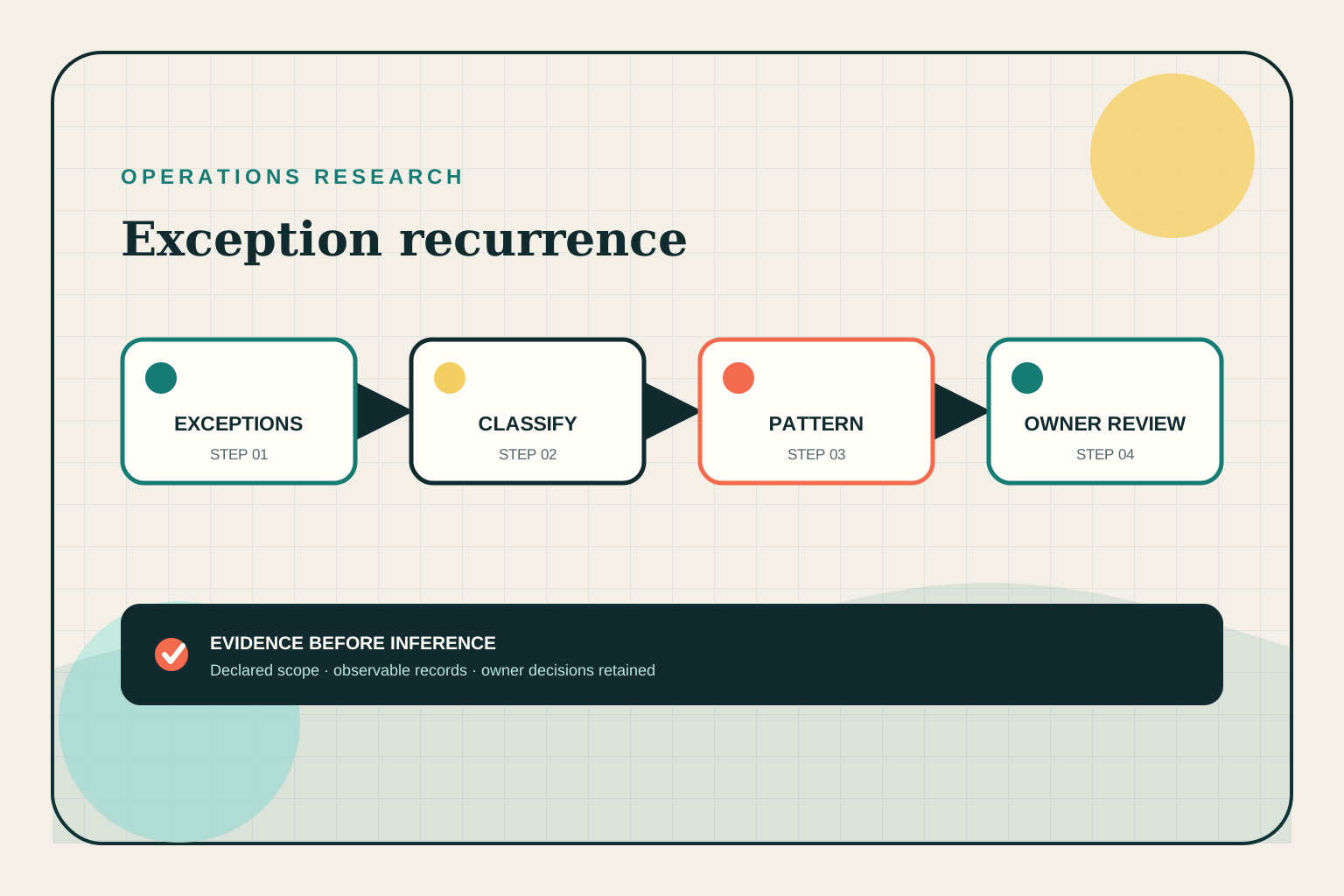
Question and scope
when exceptions recur in a Philippines outsourced operations queue, what evidence distinguishes a fixable process condition from genuinely varied work? An exception must be defined as a departure from a stated routine rule, not as any item that feels difficult. Useful categories include missing input, conflicting source, unavailable access, policy ambiguity, system failure, unusual customer consequence, and owner decision. The study covers one queue, a dated sample of routine and exception items, and the rule version in effect during the period. It does not claim that recurrence proves a staffing deficit, operator weakness, or country-level characteristic.
Design the taxonomy before reading the result. For each item, record request type, expected routine path, exception trigger, source evidence, dependency, consequence, owner, resolution, and whether the same condition appeared before. Keep an unknown category and define how reopened work is linked to the original case. Report counts and denominators by category, age, and outcome. Review a random set of routine items as a comparison; otherwise the study cannot tell whether the exception rule is simply capturing all visible difficulty. Deduplicate messages and handoffs so one case does not become an artificial cluster.
A repeated label is a fact about recording, not necessarily a repeated business cause. Several items may share a tag because a rule is broad, because reviewers copied a prior description, or because the same upstream source is incomplete. Read a sample end to end and compare the evidence with the label. If the exception is associated with more owner-wait time, rework, or customer recontact, state that association narrowly. Do not call it causal unless the design can address case mix and simultaneous changes. Have another reviewer apply the taxonomy and preserve disagreements as evidence about the definition.
The delegated role can identify the approved rule, classify a case, attach evidence, and group recurring conditions for owner review. It should not suppress an exception to protect a queue metric, invent a missing policy, grant a remedy, change a source record to make the category disappear, or treat repeated recurrence as authority to redesign the process. The owner decides whether to change policy, system configuration, access, customer treatment, or role scope. A good research result may be that the exception taxonomy is not yet reliable enough for action.
Test one intervention at a time where practical: improve an intake field, clarify a source, add an owner decision path, or update an approved instruction. Compare like cohorts before and after, keeping rule version, volume, case mix, coverage, and system events visible. Measure recurrence, resolution time, returned packets, missing evidence, and downstream rework. A lower exception count can mean better routine work, less detection, or a broader definition of “complete.” Inspect both the queue metric and a sample of records.
Limitations include rare-event volatility, small cohorts, taxonomy drift, unrecorded decisions, seasonal demand, and changes introduced at the same time as the intervention. NIST and CISA resources inform risk and control questions; SBA guidance informs role supervision; BLS provides general occupational context. None proves a benchmark for outsourced operations or supports a universal staffing conclusion. Keep sensitive customer information out of category notes unless it is necessary for the authorized reviewer.
How the study was structured
define the exception taxonomy before sampling, retain an unknown category, compare exception and routine cohorts, deduplicate reopened cases, and have a second reviewer reproduce classifications. Sources used for control context are nist.gov, cisa.gov, sba.gov, bls.gov, and ftc.gov
Evidence-led conclusion: recurring exceptions in Philippines outsourced operations are most useful as a diagnostic of intake, source, policy, access, or role boundaries when the category, denominator, and evidence are stable. Recurrence supports a targeted owner decision; it does not prove cause or justify an automatic staffing change. Recheck after a process, system, policy, owner, or demand change, and retain the prior taxonomy for comparison.
Retrieved 2026-08-20.
A recurrence finding should end with a testable next question. If missing inputs dominate, test a narrower intake requirement and inspect whether the wrong-queue rate changes. If conflicting sources dominate, assign a steward and measure unresolved conflicts rather than simply adding another reminder. If policy ambiguity dominates, sample the owner decisions and document the boundary cases that need an approved rule. If access blocks routine work, compare a controlled view with the current process while preserving the authorization boundary. Each intervention should state what evidence would support retaining it, revising it, or stopping it. This discipline matters for Philippines outsourced operations because a recurring exception can be a sign of healthy detection, not only process failure. The delegated role should be able to surface the pattern without being held responsible for deciding its remedy. Keep the source records, taxonomy version, sample frame, and owner disposition together so a later reviewer can tell whether recurrence fell because the process improved or because reporting became less complete.
Do not let the exception register become a second production queue with no owner. Give each category a destination, review cadence, and stop condition. A specialist may group records and prepare a pattern summary, but the process owner should decide whether to change an instruction or route a policy question. When a recurring condition is harmless but noisy, the owner may simplify the taxonomy; when it carries customer, financial, privacy, or security consequence, preserving the visible exception is more important than reducing the count. The research should therefore report both frequency and consequence, with a clear note about what remains unknown.
A practical recurrence review can compare the first appearance, latest appearance, and representative middle cases instead of copying every record into the report. Preserve links to the underlying evidence and state the sampling rule. If the same exception appears after an instruction update, check whether the new instruction was available, understood, and applicable to the case. If it disappears, inspect ordinary work for silent bypasses. The owner’s disposition should name the next check and the condition that would reopen the question.