
Philippines staffing research
Coverage transitions in Philippines support operations
What evidence shows that a queue remains owned when a Philippines specialist, manager, or decision owner changes coverage?
Question and scope
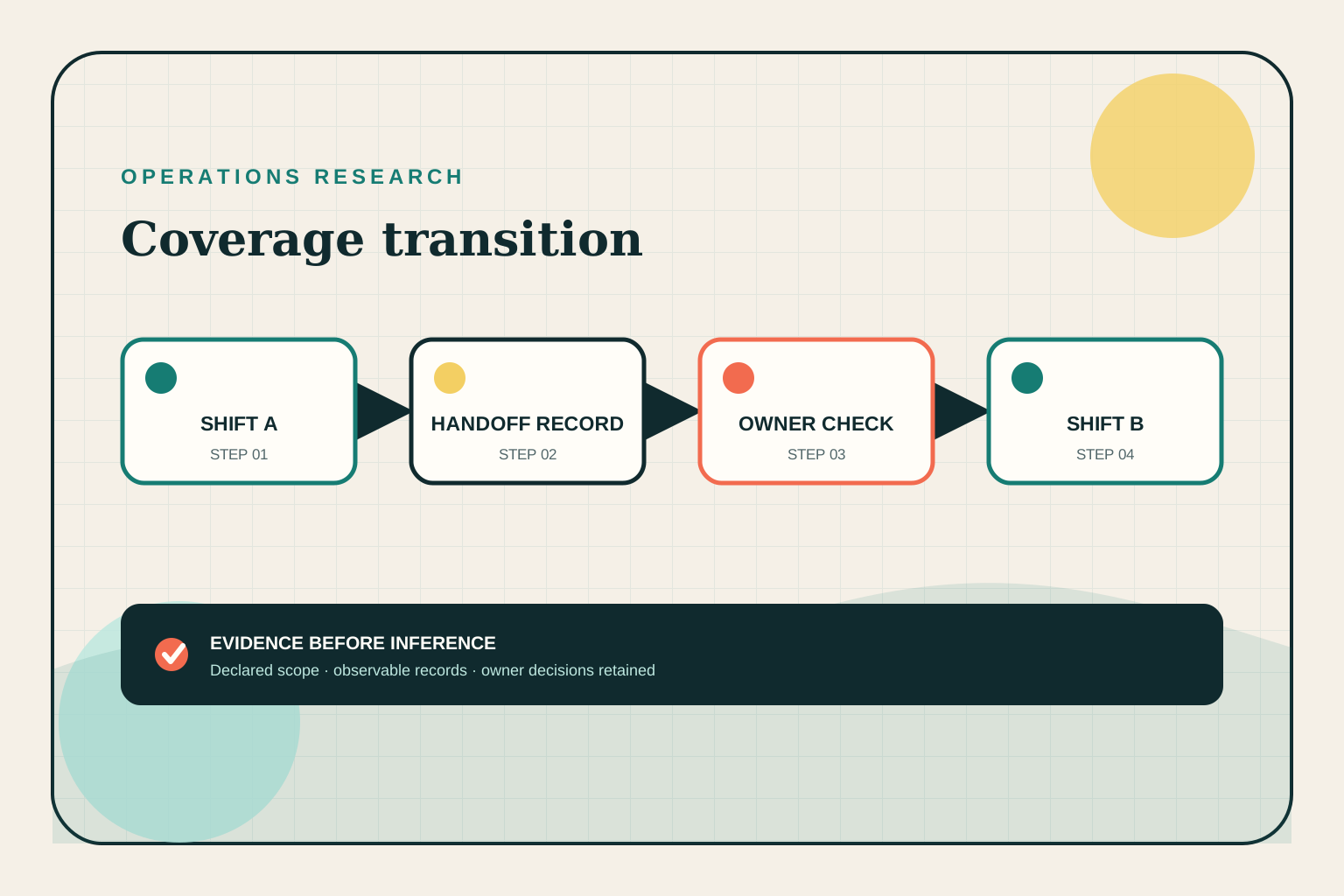
can a Philippines support queue preserve accountable ownership when work crosses a shift, absence, holiday, or owner-unavailability boundary? Coverage is often described as availability, but availability does not establish authority or continuity. This study treats a transition as a sequence: current state, outgoing owner, incoming owner, source of truth, pending dependency, next action, and escalation destination. The scope is one queue and a defined set of transition events, including ordinary handoffs and at least one exception. It does not evaluate individuals or claim that one coverage pattern works for every business. The buyer decision is narrower: which evidence shows that work can move without silently dropping a commitment or inventing authority?
Start by defining covered states. Include newly received, ready, in progress, waiting for requester, waiting for owner, blocked by system, escalated, and complete where those states fit the process. For each transition, capture the last verified state, timestamp and time zone, evidence link, named next owner, due point, and stop condition. Sample both successful and failed transitions, and include items that appeared quiet. A transition is not complete because a message was sent; the receiving role must be able to reproduce the current state and identify the next permitted action. Report incoming volume, aging, reassignments, missed acknowledgements, and unresolved exceptions by transition type.
Facts should not be confused with fault. If an item has no acknowledgement after a handoff, the record proves an evidence gap, not that the receiver ignored the work. If a backup owner opened the item but did not act, that proves access or activity, not authority or understanding. Review the handoff packet and the receiving response separately. Look for missing context, stale links, unavailable systems, unclear priorities, and a decision that had no backup. Ask a reviewer unfamiliar with the original conversation to reconstruct the item from the declared source. Their questions reveal whether the handoff carries state or merely forwards a transcript.
The Philippines specialist may prepare a transition packet, update agreed queue fields, identify dependencies, and remind the next owner under a written rule. The role should not self-authorize a priority change, make an emergency customer promise, alter permissions, approve a financial or policy exception, or declare an item complete because the normal owner is absent. A manager or owner must define backup authority and the threshold for escalation. This is especially important across time zones, where an apparently short gap may contain a full local work period but still leave a consequential decision unowned.
Test one revised handoff definition against the prior definition on comparable work. Keep the outgoing and incoming roles, queue type, business calendar, and observation period visible. Measure time to acknowledgement, time to next permitted action, returned packets, missing evidence, reopened work, and missed commitments. Include a boundary case with incomplete context and one with an owner decision. If the revised method reduces aging by closing items earlier, the measure may have worsened. Review outcomes and evidence quality together. Preserve the original transition record so later analysis can distinguish a real change from a change in logging.
Limitations include work handled outside the queue, shared accounts, unrecorded verbal decisions, seasonal coverage, and rare events that a small sample may miss. CISA and NIST guidance can inform access and risk questions, while SBA guidance is relevant to documented supervision; these sources do not establish the adequacy of a specific backup model. Avoid copying customer or employee data into a broad research file. A minimum necessary transition record is safer and easier to review.
How the study was structured
freeze the queue state dictionary and coverage calendar, sample both successful and failed transitions, and ask an independent reviewer to reconstruct the next permitted action from the handoff record. Compare acknowledgement, aging, returned packets, and missed commitments by transition type. Sources used for control context are nist.gov, cisa.gov, sba.gov, and bls.gov
Evidence-led conclusion: coverage in Philippines support operations is demonstrated when a new owner can reproduce state, authority, evidence, and next action at the transition point. Where that chain breaks, the remedy is a named backup, clearer state definitions, safer access, or owner escalation—not an unsupported promise of continuous service. Recheck after staffing, calendar, system, policy, or queue changes.
Retrieved 2026-08-20.
The strongest transition test is a reconstruction exercise performed without the outgoing operator’s private memory. Give the incoming role the declared queue record, approved source links, current coverage note, and authority map. Ask the reviewer to identify what is complete, what is waiting, what may be done next, and what must stop. Record questions and mistaken assumptions. A handoff that looks concise to its author may still be unusable to a backup. Conversely, a long transcript may contain every fact but fail to identify the decision needed. Treat the reconstruction result as evidence about record design. Retain the transition definition and compare it after the next planned absence or coverage change. Do not use a quiet period as proof that coverage is adequate; include an exception that tests the escalation path. A resilient queue is one in which the next authorized person can act from the record without guessing, while consequential choices remain visible to the owner.
Coverage research should also examine the edges of the calendar. A Philippine holiday, an owner’s local holiday, a daylight-saving shift, or an unexpected system outage can change the practical handoff window even when staffing has not changed. Declare the calendar used in the sample and record which role owns the queue during the gap. If no one has authority to decide, label the state “owner wait” rather than assigning it to the person who happens to monitor the queue. That simple distinction prevents activity from being mistaken for coverage.
For each transition, ask whether the incoming role had enough evidence to protect the existing commitment, not whether the person was online. Preserve the outgoing note, incoming acknowledgement, and any owner response. If the handoff failed, classify the failure as missing context, missing access, unclear authority, unavailable reviewer, or an unrecorded decision. Those categories lead to different interventions. A clearer record will not solve an absent decision owner, and an extra person will not solve a missing source.