
Philippines staffing research
Process-change evidence in offshore operations research
Which records show that an offshore workflow change was approved, effective, and safe to interpret?
Question and scope
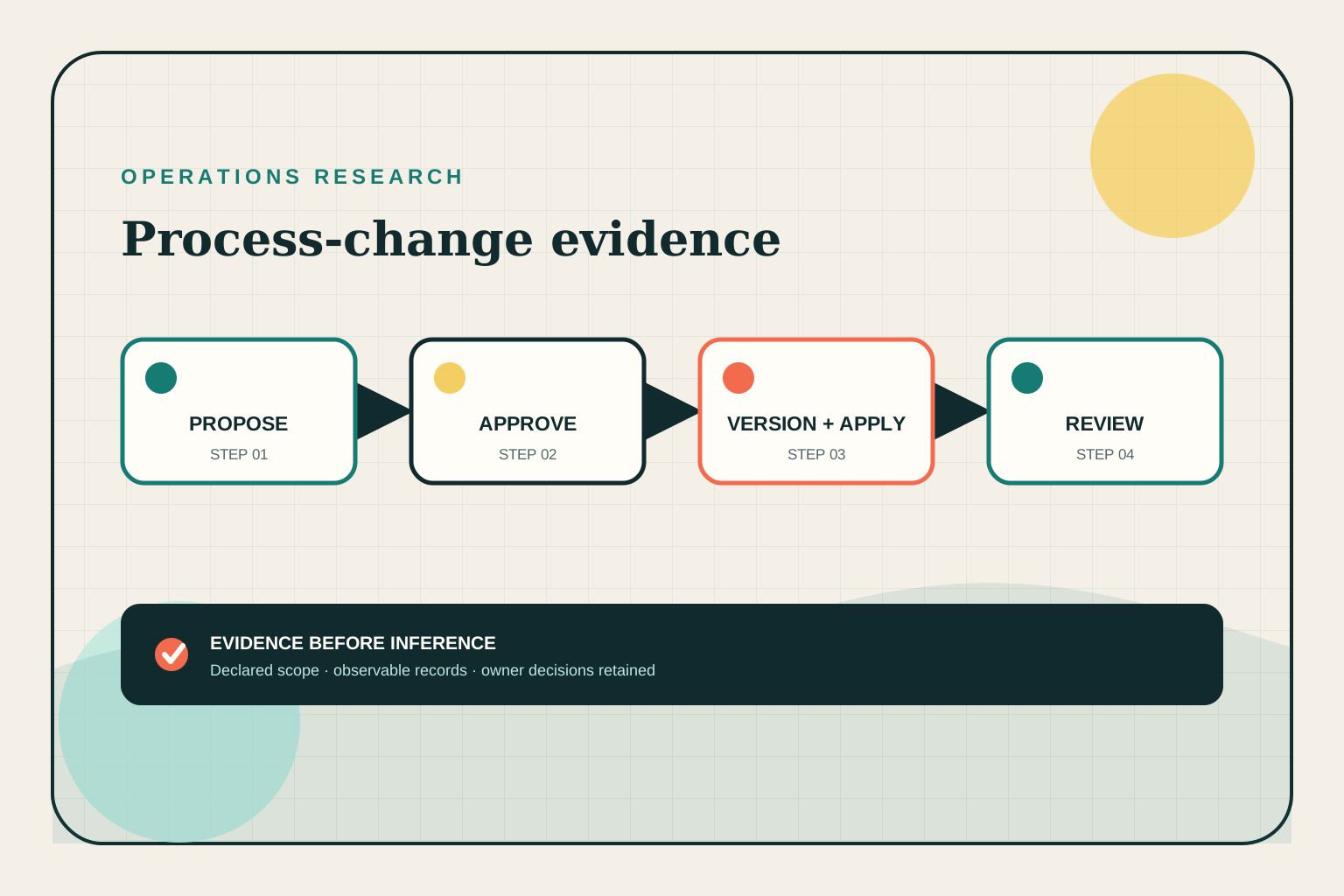
how can an offshore operations team distinguish an approved process change from a suggestion, experiment, or local workaround? This distinction matters when a Philippines support lane is asked to follow instructions that change over time. A message in a chat channel may be informative without being an authorization. The study follows one workflow through a defined change period and examines the proposal, decision authority, effective date, affected roles, source-of-truth update, training evidence, and post-change observation. It does not judge whether a change was strategically wise; it asks whether a later reviewer can establish what changed and who approved it. Methodology: reconstruct the version history, classify each record by approval state, sample implementation evidence, and compare like cohorts while recording concurrent changes and rollback conditions.
Define the change record before sampling. At minimum, capture the old rule, proposed rule, reason, risk or dependency, approver, effective date, affected queue, source location, communication path, and rollback or exception instruction. Sample approved changes, rejected proposals, temporary experiments, and recurring local workarounds. Include one item where the source was updated late. The distinction between “proposed” and “effective” should be a field, not an inference from message order. Preserve the original record and the current version so a research reader can reconstruct the transition without relying on memory.
Facts must not be upgraded into conclusions. A new instruction posted on a date proves publication, not approval. A changed form proves implementation activity, not that every operator saw or understood the change. A lower rework count may follow the change, but it does not prove causation without considering demand, case mix, staffing, and other concurrent edits. Record observations separately from analysis and identify what would falsify the interpretation. If two sources disagree, route the conflict to the owner instead of selecting the most recent message as the rule.
A delegated specialist can locate the current approved instruction, compare it with the prior version, note effective dates, and identify records affected by the transition. They should not self-authorize a workaround, rewrite a policy, broaden access, or announce a consequential exception. The owner of the process retains authority to approve and retire rules. A manager or designated reviewer should own the change log and the decision about whether a pilot may become standard. This boundary protects the business from silent drift while still allowing the offshore lane to surface practical implementation evidence.
Evaluate a change through a staged evidence design. First test whether the record is complete and the source is discoverable. Next sample implementation records for correct version, acknowledgement, and permitted use. Then compare a defined set of outcomes such as rework, returned items, clarification cycles, or exception routing, while keeping counts and denominators visible. Do not treat a post-change improvement as proof if the eligible population changed. Record outages, training, demand spikes, and policy changes. If a rollback occurred, study it as evidence about the boundary conditions rather than hiding it as failure.
What this evidence cannot establish
version histories may be incomplete, chat decisions may be difficult to preserve, and people may follow a local copy after the canonical instruction changes. A process-change study cannot establish that an offshore team caused or prevented a business outcome. NIST and CISA materials help frame risk, traceability, access, and recovery questions; SBA material helps frame management and supervision questions. They do not certify a workflow or create a change-control requirement for this company. Keep copied records minimal where they contain customer or commercial information.
Evidence-led conclusion: process-change evidence is trustworthy when approval, effective date, source version, affected role, and observed implementation are linked. For offshore operations, the most useful result may be that a proposed improvement is not yet safe to treat as a rule. That finding protects the owner from accidental policy drift and gives the delegated lane a clear stop condition.
Retrieved 2026-08-21.
The final report should show one change that completed the full path and one that stopped at proposal or required owner clarification. State the smallest corrective action: update the source, name an approver, retire a local copy, or define the experiment window. Repeat the review after a material system, policy, access, or role change. A reliable change log is not bureaucracy for its own sake; it is evidence that the work being delegated is governed by a current and reviewable rule. Include the local interpretation that was prevented, if any, and explain how a routine operator should recognize the boundary next time. A change that improves speed but weakens traceability should not be accepted as a clear win. Conversely, a temporary increase in review can be evidence that the new control is detecting exceptions honestly. The owner should choose the acceptance threshold before observing the result, so the research does not drift toward whichever measure looks favorable after implementation. Record who could approve the change, which source version was active at each observation, and whether training reached every affected role. If the evidence is incomplete, preserve the uncertainty rather than inferring approval from later behavior. This makes a process-change result useful for deciding whether to continue a pilot, repair the source of truth, or stop the local workaround. Also record whether the observed cohort was comparable before and after the change, whether any rollback occurred, and which evidence would disconfirm the claimed improvement. The report should distinguish an approved change from an observed workaround even when later metrics look better. A small increase in review time can be an intentional control, while a faster result can be misleading if exceptions were simply omitted.
Interpretation guardrail: this report is a bounded study for a defined process, sample, and decision, not a universal benchmark for offshore work. Keep the evidence period, source system, reviewer rule, and exclusions beside every result. When a finding changes an operating choice, name the authorized owner, the smallest reversible test, the stop condition, and the evidence that would contradict the proposed interpretation. Separate routine preparation from customer, financial, privacy, security, policy, and personnel decisions. A Philippines specialist may gather, compare, classify, and route evidence under approved instructions; the accountable owner decides exceptions and consequential outcomes. Recheck the result after a material policy, system, access, calendar, role, or case-mix change. Do not turn a lower count into proof of improvement if recording behavior changed, and do not turn a higher count into proof of failure if detection improved. Preserve uncertainty when the source cannot distinguish competing explanations. This makes the report useful to a buyer planning safe delegation while keeping the public claim narrower than the evidence supports.