
Philippines staffing research
Claim-to-source verification for offshore research support
How should an offshore research lane test whether a source actually supports the wording a buyer may rely on?
Question and scope
does each material claim in an offshore research brief have a source that supports its wording, population, period, and certainty? A list of reputable URLs is not enough. A source can be authoritative yet irrelevant to the sentence written from it, or a general observation can be inflated into a guarantee about a Philippines support role. This study examines a bounded brief, its claim register, and a sample of headline and supporting statements. It is a verification method, not legal advice, a market forecast, or a guarantee of an outsourcing outcome. Its decision purpose is to identify which claims are publishable, which need narrower language, and which should be removed. Methodology: inventory every material claim, classify its evidence scope, have a second reviewer test source fit, and report supported, partial, unsupported, stale, inaccessible, and out-of-scope results with denominators.
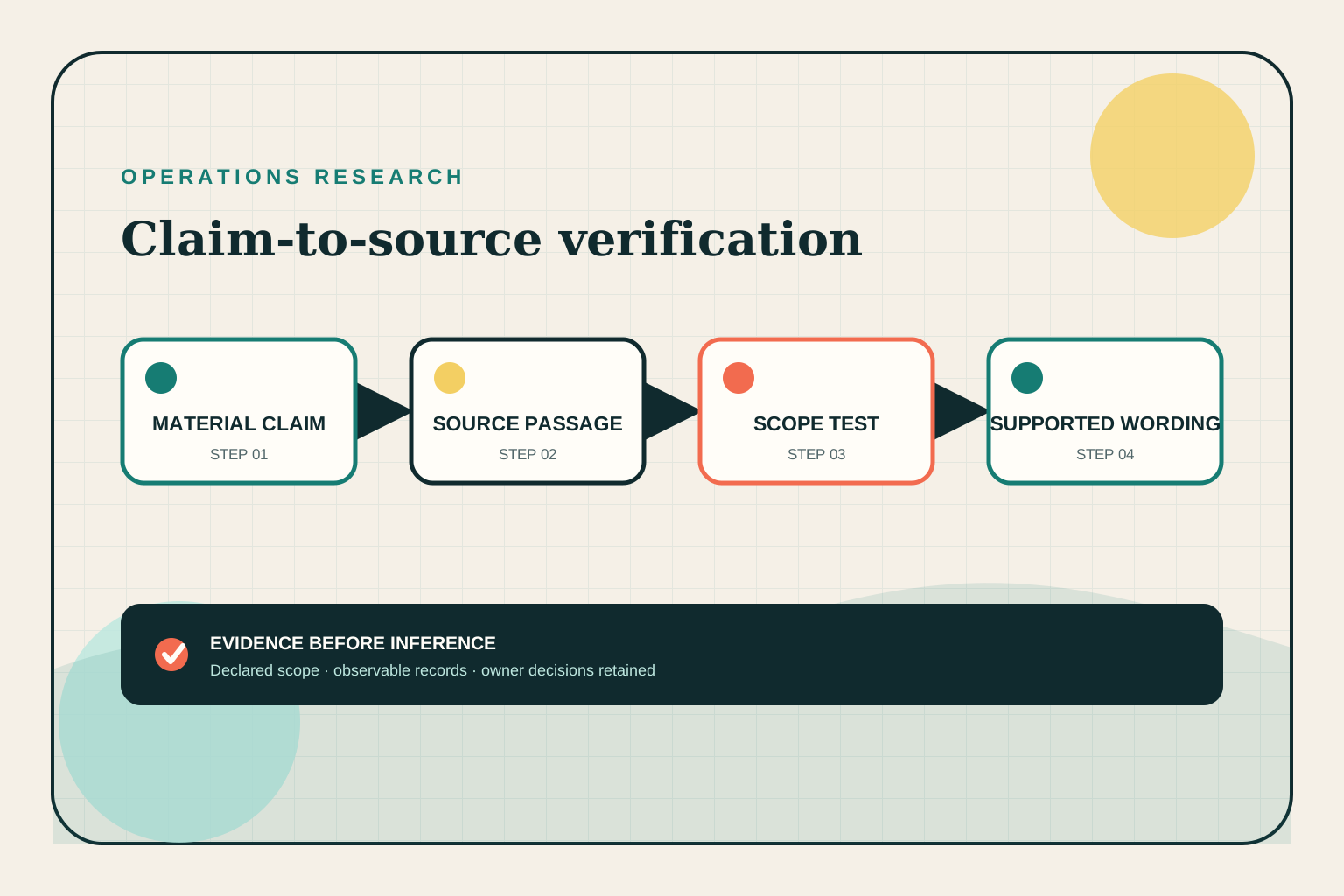
Start with the claim rather than the bibliography. Record the exact sentence, claim type, population, geography, period, denominator, source publisher, URL, relevant section, access date, evidence strength, and reviewer disposition. Classify sources as official government material, recognized standards, research literature, official organizational guidance, or secondary commentary. Check whether a statistic has a defined sample and whether a qualitative statement is being treated as quantitative evidence. Preserve short notes and links rather than copying large passages. When a page changes or disappears, mark the claim as needing review; do not silently replace it with a vaguely related page.
Verification requires separating what the source says from what the writer infers. A government page may describe a control principle without proving that a company follows it. A study of one population may not support a claim about every offshore team. A source date may establish publication timing but not current validity. Ask a second reviewer to decide whether the source supports the sentence as written and to identify any missing caveat. Record disagreement at claim level. If the claim can be supported only after changing “will” to “may,” or narrowing the population and period, make that revision visible rather than presenting the original certainty.
An offshore research specialist may locate sources, capture relevant evidence, compare definitions, maintain the claim register, and flag unsupported wording. They should not invent a citation, quote out of context, fabricate a statistic, or present a business result that the evidence does not measure. An authorized owner or editor decides the publication standard and whether a claim is important enough to remove. This boundary is central to a useful support role: the specialist reduces search and verification work while keeping judgment and public accountability with the person who can authorize the final statement.
Test the method with a complete set of headline claims and a random sample of supporting claims. Report supported, partially supported, unsupported, stale, inaccessible, and out-of-scope classifications with counts and denominators. Review claims that rely on several sources as a chain; one source may support context while another supports the narrow fact. Compare reviewer agreement and correction time. A high citation count can coexist with weak evidence if links are decorative. A shorter brief with direct claim-to-source fit is stronger than a longer brief built from generic citations.
What this evidence cannot establish
web pages change, archives may be inaccessible, terminology differs across studies, and a source may omit the operational detail a buyer actually needs. Verification cannot prove that a recommendation will work in a particular business, nor can it replace legal, security, privacy, or procurement review. NIST, CISA, and SBA materials provide useful context for control and management questions, but they do not validate any company-specific statement. Minimize personal and confidential information in research notes and use approved storage and access.
Evidence-led conclusion: offshore research quality depends on claim-to-source fit, scope, and explicit uncertainty rather than the number of URLs attached. For a Philippines operations brief, a safe result may be a narrower claim, a stated evidence gap, or a request for owner confirmation. Those are successful verification outcomes because they prevent unsupported certainty from entering a buyer decision.
Retrieved 2026-08-21.
The final register should preserve the original claim, the reviewer result, the edit or removal decision, and the access date. Recheck material claims after a source update, policy change, or new publication date. When a source cannot support a sentence, do not reward the draft for retaining the citation; reward it for making the evidence boundary honest. That practice gives an offshore research lane a clear role and gives the owner a defensible basis for deciding what belongs in public copy. For high-consequence claims, add a second check that asks whether the evidence is current, whether the language implies a guarantee, and whether the source concerns the same population and decision. Keep those checks separate from grammar editing. A polished sentence can still exceed its evidence. The strongest research packet shows removed claims as well as retained claims, because the removal decision demonstrates that the reviewer tested scope rather than merely collecting links. Revisit the register when a source changes its definitions or when the business begins using the brief for a different decision. Record the exact revision that changed a claim, the source passage or table that controlled the decision, and the reason a narrower wording was chosen. If a source supports only context, label it as context rather than evidence for the operational claim. A route-local register is strongest when another reviewer can reproduce both the retained wording and the removed wording without private explanation.
Interpretation guardrail: this report is a bounded study for a defined process, sample, and decision, not a universal benchmark for offshore work. Keep the evidence period, source system, reviewer rule, and exclusions beside every result. When a finding changes an operating choice, name the authorized owner, the smallest reversible test, the stop condition, and the evidence that would contradict the proposed interpretation. Separate routine preparation from customer, financial, privacy, security, policy, and personnel decisions. A Philippines specialist may gather, compare, classify, and route evidence under approved instructions; the accountable owner decides exceptions and consequential outcomes. Recheck the result after a material policy, system, access, calendar, role, or case-mix change. Do not turn a lower count into proof of improvement if recording behavior changed, and do not turn a higher count into proof of failure if detection improved. Preserve uncertainty when the source cannot distinguish competing explanations. This makes the report useful to a buyer planning safe delegation while keeping the public claim narrower than the evidence supports.